How to Take Steady Photos from a Moving Boat: 8 Practical Tips

Labuan Bajo Productions Editorial Desk
November 16, 2026
12 min read
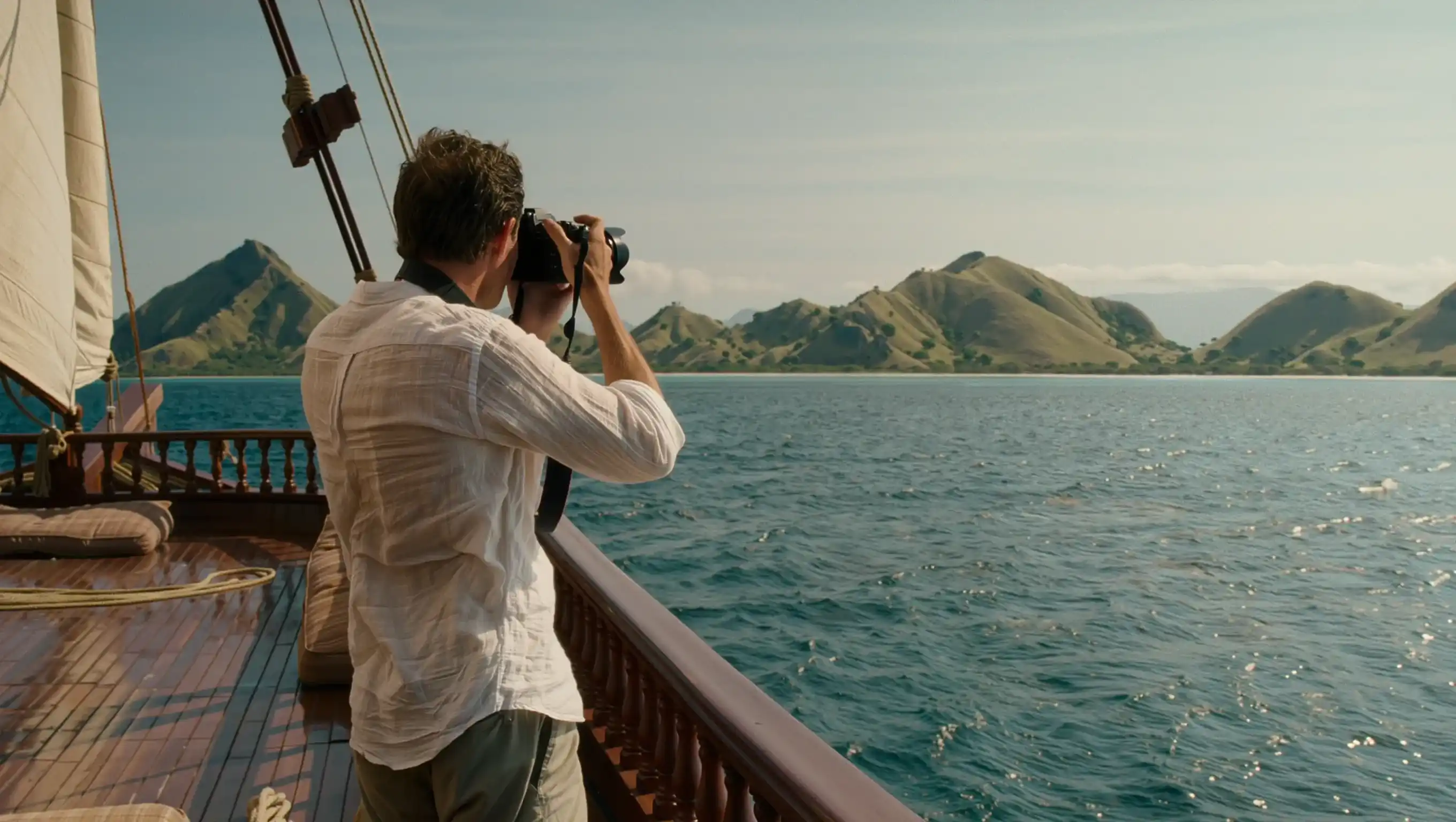
How can you capture sharp photos while you’re on a moving boat? Taking pictures during a boat journey comes with its own challenges because the movement caused by waves can make it difficult to keep your camera steady. As a result, your photos may appear blurry, lose focus, or have poorly aligned compositions, even when you try your best to hold the camera properly.
This article covers how to take steady photos from a moving boat, from finding the right body position and adjusting your shutter speed to choosing the right lens and making the most of your camera’s stabilization features. You can apply these techniques during any sea journey, including a sailing trip in Labuan Bajo, to capture sharper images without missing out on the memorable moments along the way.
Key Takeaways
- Choose a shooting position near the middle of the boat and maintain your balance to minimize the impact of the boat’s movement on camera stability.
- Use a fast shutter speed, starting at 1/500 second, and adjust it based on the boat’s speed, sea conditions, and the subject you want to photograph.
- Enable image stabilization, choose a lens with a suitable focal length, and use Continuous Autofocus to help capture sharper images.
- Use burst mode and take advantage of moments when the boat is moving more gently to increase your chances of getting sharp, in-focus photos.
- If you want to enjoy your sailing trip without worrying about camera settings, consider professional documentation services from Labuan Bajo Productions to capture your journey through photos and videos.
How to Take Steady Photos from a Moving Boat
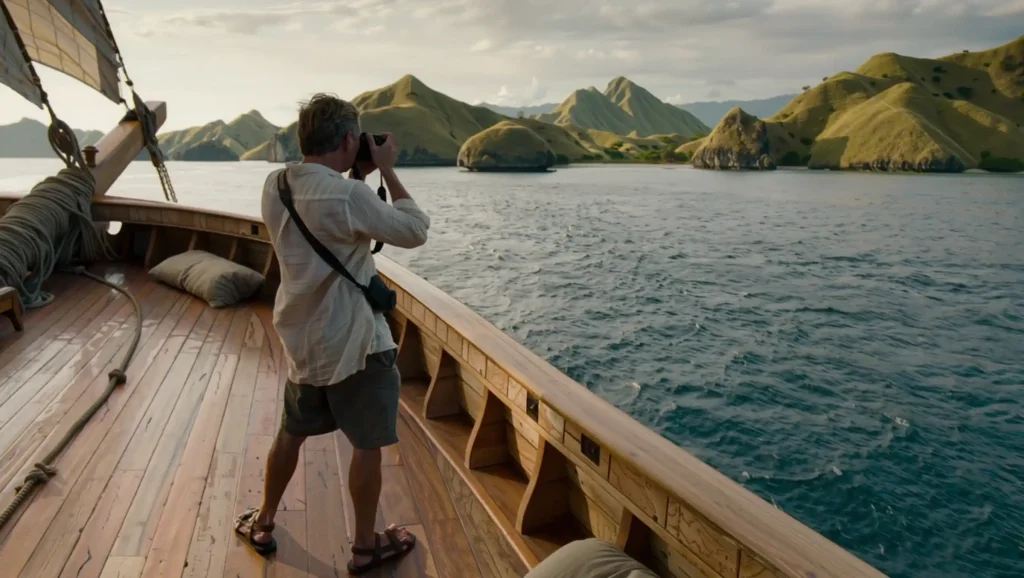
Here are several practical ways to keep your photos steady while shooting from a moving boat, from adjusting your body position to choosing the right moment to take a picture.
1. Choose a Shooting Position Near the Middle of the Boat
The first thing to consider is where you position yourself when taking photos. Don’t automatically head to the front of the boat just because you want a wider view. The middle section of a boat is generally a more comfortable place to take pictures because the up-and-down movement tends to be less pronounced than at the bow or stern. From this position, you’ll have a better chance of maintaining your balance while keeping your camera steady.
Also, choose an area with enough room to move around without interfering with the crew or other passengers. Make sure you’re not standing on a slippery surface or too close to the edge of the boat. Once you’ve found a suitable spot, you can start adjusting your shooting angle. This way, changes in the boat’s movement won’t make it too difficult to frame your subject.
2. Adjust Your Body Position to Maintain Balance
Aside from where you stand on the boat, your body posture also plays an important role in keeping your camera steady. If you rely only on your hands to stabilize the camera, even small movements from the boat can affect the direction of your shot.
To minimize this, try following these techniques:
- Stand with your feet shoulder-width apart to create a more stable base.
- Slightly bend your knees so your body can adjust more naturally to the boat’s movement.
- Keep both elbows close to your body when holding the camera.
- Hold the camera with both hands, using one hand to support the lens and the other to operate the camera.
- Avoid locking your knees or standing too rigidly when the boat moves through the waves.
If possible, you can also take photos while sitting down or lowering your center of gravity slightly. However, make sure this position doesn’t restrict your movement and remains safe. One important thing to remember is that you shouldn’t try to resist every movement of the boat by keeping your body completely rigid. Instead, maintain a stable stance while gradually adjusting to the boat’s motion. This technique helps minimize unnecessary camera movement.
3. Use a Faster Shutter Speed
One of the camera settings that has the greatest impact on photo sharpness when shooting from a boat is shutter speed. This setting determines how long the camera sensor is exposed to light when you take a picture. The longer the shutter stays open, the greater the chance that camera or subject movement will appear as motion blur. On the other hand, a faster shutter speed can help freeze movement and produce sharper images.
When taking photos from a boat, you can start with the following settings:
| Photographing Subject | Recommended Shutter Speed |
| Seascapes and islands | 1/500 second |
| People doing activities on the boat | 1/500–1/1000 second |
| Other moving boats | 1/1000 second |
| Birds or fast-moving subjects | 1/1600–1/2000 second |
These figures are not fixed settings because the ideal shutter speed still depends on the wave conditions, boat speed, and available light.
For example, when the boat is moving quite fast or passing through choppy waters, you may need to use an even faster shutter speed. Meanwhile, when the boat is cruising slowly through relatively calm waters, 1/500 second can be a good starting point. You don’t need to stick to just one setting. Adjust your camera based on the shooting conditions to keep your photos sharp without making them too dark.
4. Enable Image Stabilization on Your Camera
If you’re using a mirrorless or DSLR camera, don’t forget to check its image stabilization settings before you start shooting. This feature helps reduce camera shake when you’re taking photos handheld.
There are several types of image stabilization systems that may be available on your device:
- OIS (Optical Image Stabilization): A stabilization system that works through optical elements inside the lens.
- IBIS (In-Body Image Stabilization): A stabilization system built into the camera body that moves the sensor to compensate for camera shake.
- EIS (Electronic Image Stabilization): A digital stabilization method that is commonly found in smartphones and video cameras.
If your camera and lens support these features, enable them according to your device’s instructions. However, keep in mind that image stabilization cannot completely eliminate the effects of a moving boat. It is more effective at reducing camera shake caused by hand movements. Meanwhile, fast-moving subjects and changes in the boat’s position still need to be managed with an appropriate shutter speed.
Read more: 7 Camera Angle Techniques You Need to Know for Stunning Documentation
5. Choose a Lens with the Right Focal Length
Choosing the right lens is another important part of boat photography. The longer the focal length, the more noticeable the effect of even small movements can be in your photos. If your goal is to capture seascapes and the island scenery of Labuan Bajo, a wide-angle lens can be a practical choice.
Here are several types of lenses you can consider:
| Lens Type | Best For |
| Wide-angle 16–35 mm | Photographing seascapes, islands, and the atmosphere on board |
| Standard 24–70 mm | Capturing people, activities, and the overall sailing trip experience |
| Telephoto 70–200 mm | Photographing subjects located farther away from the boat |
Wide-angle lenses are generally easier to work with when trying to maintain image sharpness compared to telephoto lenses under the same shaky conditions. However, that doesn’t mean you should avoid using a telephoto lens altogether. If you want to photograph distant subjects, make sure your shutter speed is fast enough and your body position remains stable. By matching your focal length to the subject you want to capture, you can reduce the need to constantly adjust your camera position while the boat is moving.
6. Use Continuous Autofocus for Moving Subjects
What if you want to photograph your friends enjoying activities on the boat or another boat passing in the distance? In these situations, keeping your camera steady isn’t enough. You also need to make sure your camera can maintain focus as the subject moves. One way to do this is by using Continuous Autofocus. This mode allows your camera to keep adjusting its focus as the subject changes position.
Different camera brands may use different names for this feature, including:
- AF-C on Sony, Nikon, and Fujifilm cameras.
- AI Servo on Canon cameras.
- Continuous AF on several other camera models.
When using this mode, point the focus area toward the subject you want to capture. The camera will attempt to maintain focus as the subject moves within the tracking area. Meanwhile, if you’re photographing a relatively stationary island landscape, Single Autofocus or AF-S may be a more suitable option. In other words, your autofocus mode should depend on the subject you’re photographing, not just on whether the boat is moving.
7. Use Burst Mode to Capture Sharper Photos
Sometimes, even when you’ve selected a fast shutter speed and are holding your camera correctly, not every photo turns out sharp. This is perfectly normal because a boat’s movement can be difficult to predict consistently. To work around this, make use of burst mode, also known as continuous shooting. This feature allows your camera to capture multiple photos in quick succession while you hold down the shutter button.
For example, if you want to photograph a friend standing at the front of the boat, take several frames in a row. From those shots, you can choose the one with the best expression, composition, and sharpness.
This technique is also useful when photographing another boat passing by or birds flying over the water. However, don’t rely solely on taking as many photos as possible. Keep paying attention to your focus and shutter speed to increase your chances of capturing sharp images.
8. Take Photos When the Boat Is Moving More Gently
The final technique, which is just as important as the others, is paying attention to the boat’s movement. You don’t have to take photos all the time, especially when the boat is passing through relatively large waves. Try observing the boat’s movement for a while. You may notice moments when the boat feels more stable before responding to the next wave.
Take advantage of these moments to capture your photos. If you’re photographing a landscape, point your camera toward the subject and prepare your composition in advance. Once the boat feels more stable, press the shutter button. This approach helps reduce the risk of motion blur caused by the boat’s movement without requiring you to constantly increase your shutter speed or ISO.
Also, don’t force yourself to take photos when conditions on the boat aren’t suitable. Always prioritize your safety and wait until it’s safe to start shooting again.
Recommended Camera Settings for Photographing from a Moving Boat
As a reference, here are some recommended camera settings for photographing from a moving boat, depending on the subject you want to capture.
| Camera Settings | Seascapes and Islands | People and Activities on the Boat | Other Boats or Distant Subjects |
| Shutter speed | 1/500 | 1/800–1/1000 | 1/1000 |
| Aperture | f/5.6–f/8 | f/2.8–f/5.6 | f/5.6–f/8 |
| ISO | Auto ISO | Auto ISO | Auto ISO |
| Autofocus | AF-S | AF-C | AF-C |
| Focal length | Wide-angle | Standard | Telephoto |
These settings can serve as a starting point when using a mirrorless or DSLR camera. However, there are a few things to keep in mind when applying them.
- First, choose an aperture based on the depth of field you want to achieve. For landscape photography, an aperture between f/5.6 and f/8 can help keep various elements within the frame sharp. Meanwhile, a wider aperture is suitable when you want to separate your subject from the background.
- Second, make use of Auto ISO so your camera can automatically adjust sensor sensitivity as lighting conditions change. This can be particularly helpful when the boat moves from a bright open area into a more shaded section.
- Third, always review your photos after taking a few frames. Check whether your subject is in focus, the horizon is relatively straight, and the image details remain clear.
By making a habit of reviewing your photos, you can quickly determine whether your camera settings need further adjustment.
Hire Professional Photography Services So You Don’t Have to Take Every Photo Yourself
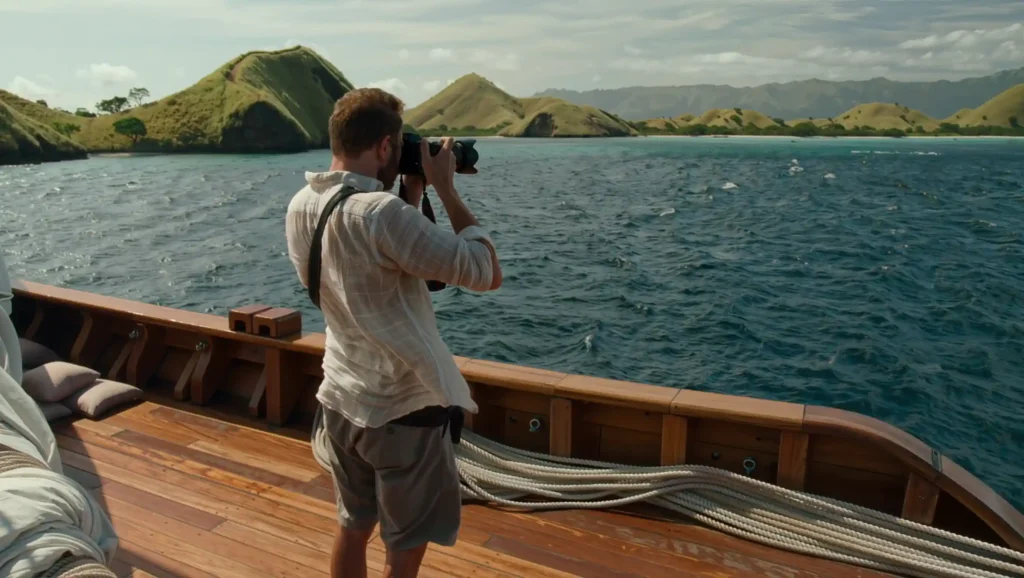
Practicing different photography techniques while a boat is moving requires extra attention. You need to maintain your body position, adjust your shutter speed, keep your subject in focus, and adapt your camera to the boat’s movement. If you’d rather enjoy your sailing trip without constantly worrying about your camera settings, hiring a professional documentation team can be a practical option.
Labuan Bajo Productions offers professional documentation services in Labuan Bajo through its photography and videography packages. With the help of a dedicated documentation team, you can focus on enjoying your journey while the memorable moments throughout your sailing trip are captured in photos and videos. You also won’t have to worry about adjusting camera settings or missing special moments because you’re too busy taking pictures yourself.
Capture Every Moment of Your Labuan Bajo Sailing Trip with Labuan Bajo Productions!
Learning how to take steady photos from a moving boat requires practice and an understanding of photography techniques. From choosing a position near the middle of the boat and maintaining your balance to using a fast shutter speed and enabling image stabilization, each technique can help you capture sharper photos throughout your journey. However, if you’d rather enjoy your sailing trip without constantly adjusting your camera, hiring a professional documentation team can be a more convenient option.
Labuan Bajo Productions is here to help capture the highlights of your journey, especially when you’re visiting Labuan Bajo, through professional photography and videography services. This way, you can focus on enjoying every activity during your sailing trip while our documentation team captures those valuable moments for you. Contact our team today and explore our Labuan Bajo trip documentation packages to find the right option for your travel needs!